

Professor Richard Turnbull – a short tribute
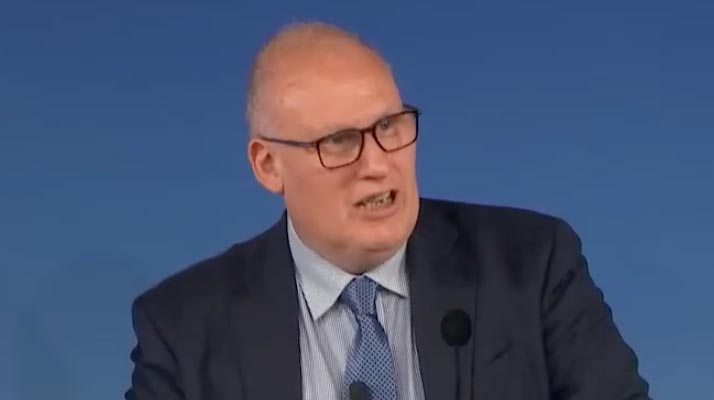
Richard was the founding director of the Centre for Enterprise, Markets and Ethics. He was a visiting professor in the Business School at St. Mary’s University. He made a number of contributions to the life of St. Mary’s, including organising high profile events involving academics, business leaders and policy thinkers. He also guest lectured on the MA in Catholic Social Teaching.
Richard’s position at St. Mary’s University was the icing on a very fine cake. Richard had a distinguished career. He had a graduated in economics and then qualified as an accountant. Whilst at university as an undergraduate, he became a Christian. His ability to merge economics and theology made him especially effective in contributing to Christian social thought. Richard was ordained in the Anglican Church and then became master of the Anglican Wycliffe Hall (Oxford University). He was able to combine the study of ethics and business with great expertise, especially drawing on insights from scripture.
Apart from his role as Master of Wycliffe, Richard was active in Anglican life. He served as assistant curate of Christ Church, Portswood; vicar of Chineham; as a member of the General Synod of the Church of England; and as a member of the Archbishops’ Council.
One of many important contributions by Richard was in the field of Quaker capitalism. This might appear niche, but it is an extraordinarily interesting and important phenomenon in the field of business ethics which has implications for businesses today. There were about 20,000 Quakers in England and Wales in the 19th century, but all of the following companies were founded by Quakers, and their management was explicitly based on Quaker principles: Cadbury; Rowntree’s; Fry’s; Huntley & Palmers; Jacobs; Lloyds; Barclays; Clarks; Friends Provident; as well as many others. These grew into some of Britain’s most important businesses. It is especially sad that Richard died just as he was due to start work on a commission from Cambridge University Press which would have produced the definitive work, in the UK, on this topic. Richard’s intellectual work went way beyond this important field. He wrote several books, papers and pamphlets, most recently contributing to the Catholic Bishops’ Conference of England and Wales document, “Render unto Caesar” – typically, it was a scriptural perspective on taxation.
A longer tribute can be found at: Rev. Dr. Richard Turnbull: Scholar, Teacher, Friend – Religion & Liberty Online Richard was also chairman of the Christian Institute which has done important work on life issues, especially with regard to assisted suicide in the last few years. Their tribute is at: Christian Institute Chairman Revd Dr Richard Turnbull promoted to glory – The Christian Institute
At this very sad time, we send our condolences to Richard’s wife, Caroline, and his four children. I know that they will appreciate the prayers of all who read this site. May he rest in peace.
Webinar: War and the Wounded Earth: The Impact of Conflict on Creation
 In honour of the 2024 Season of Creation’s theme, “To Hope and Act with Creation”, this webinar will delve into the profound ecological consequences of armed conflict on our common home. The panel of experts will aim to examine how warfare and conflict directly contribute to environmental degradation, disrupt international cooperation for environmental protection, and shift societal priorities away from sustainable environmental practices.
Date: Fri 18th October 2024
Time: 1pm-2pm
Venue: Online
Register: Register Via Zoom
—
Pioneering parishes: How local church communities can become guardians of creation
The Catholic Church calls on us to work to promote and protect the natural environment, including by reducing carbon emissions.
Date: Wednesday 4th September 2024
Time: 7:00pm to 8:00pm
Venue: Online

St Mary’s University, in collaboration with Cafod and the Catholic Bishops’ Conference of England and Wales, have organised an event “Pioneering parishes: How local church communities can become guardians of creation” which builds on St Mary’s University’s “guardians of creation” project designed to provide practical guidance to parishes.
You can sign up here: https://cafod.org.uk/news/events/pioneering-parishes
—
In Conversation with Edward Stourton
 You are all warmly invited to an event at St. Mary’s University, “In Conversation with Edward Stourton” on Wednesday 18th September 2024 from 6:00pm to 7:00pm at St Mary’s University with drinks to follow.
Edward Stourton has worked in broadcasting for 45 years, and regularly presents Radio Four programmes such as Sunday, the World at One and the World this Weekend. He has been a foreign correspondent for Channel 4, ITN and the BBC, and for ten years he was one of the main presenters of the Today programme. He has published 12 books.
To book your place at the event, please follow this link: https://www.stmarys.ac.uk/events/2024/interview-and-qa-with-broadcaster-and-presenter-edward-stourton .
—
St Mary’s academics present at key international conference focused on “Catholic universities: in solidarity with their partners and colleagues in conflict zones

Professor Carole Murphy, Dr Ashley Beck and Ms Maggie Doherty recently presented at an important international conference exploring how to build resilience in solidarity with partners and colleagues in conflict zones. The conference was led and organised by the University of Notre Dame, alongside a Consortium of ten Catholic Universities. It took place at the Notre Dame Rome campus from 31 July to 2 July.
Book launch and launch of St Mary’s University Press
You are warmly invited to the launch of St Mary’s University Press and the launch of its first book, “Catholic Social Thought, the Market and Public Policy – twenty-first century challenges”. The book is edited by Philip Booth and Andre Alves, with contributions from: Hugo Chelo, Inês Gregório, Andrew M. Yuengert, Martin Schlag, Jay W. Richards, Robert G. Kennedy, Kaetana Numa, Stephen Nakrosis, Samuel Gregg, Russell Sparkes and Leonardo Franchi. It includes forewords by Rt. Hon. Ruth Kelly (member of the Vatican Council for the Economy) and the Most Rev. John Wilson, Archbishop of Southwark.
27th February 2024
The launch will be held at St. Mary’s University, Waldegrave Drawing Room, starting at 6pm.
The Common Good: What does it mean?’

These days, the vocabulary of the common good is liberally deployed in political, religious and charity sectors. But too often, the term is misapplied and misunderstood. When used to promote utilitarian or utopian ideas, it can provide cover for coercive ideologies that do more harm than good. Such ideas are antithetical to the conception of common good in the Christian, Jewish and Aristotelean traditions, which are underpinned by fundamental human principles such as love, reciprocity, relationship, freedom and mutual respect. Given this background, a coalition of Christian-inspired organisations active in the public square are putting together a series of events to explore the meaning of the common good and the role of the family, society and government in its promotion.
The first event will explore how the common good in its true sense relates to a settled pluralism of identities and interests, the shared life of a society to which everyone freely contributes and is able to flourish and reach fulfilment. It will also explore how important that is given the background of current political discourse. This event will be chaired by Ruth Kelly and feature three discussants Professor Phillip Booth (St Mary’s University, Twickenham), Jenny Sinclair (Together for the Common Good), Dr Sam Bruce (Centre for Social Justice).
This is the first of four events in the series: ‘The Common Good: what does it mean for families, society and government’ produced in partnership between Together for the Common Good, The Centre for Social Justice, Caritas Social Action Network and the Benedict XVI Centre at St Mary’s University Twickenham. The series is sponsored by CCLA, one of the UK’s largest ethical fund managers, home of the Catholic Investment Fund.
Related posts:

Punishment and prisons in 21st century Britain
The Benedict XVI Centre at St. Mary’s University, together with the Caritas Social Action Network and the Catholic Bishops’ Conference of England and Wales, evening discussion on Punishment and Prisons in the 21st Century with Bishop Richard Moth and Rev Jonathan Aitken, chaired by Professor Philip Booth.
The UK has an unusually large number of people in prison relative to its population compared with other Western countries. Most Christians would recognise that human sinfulness leads to situations where some people deserve serious punishment and that prison might be necessary to protect the population from some people who have committed criminal acts. However, this does not mean that we should be comfortable with ever-growing numbers in prisons which are often unsafe environments for both prisoners and prison staff and also places without hope.
Rev Jonathan Aitken is a former cabinet minister who himself was once a prisoner and is now an Anglican priest and part-time prison chaplain. Bishop Richard Moth is Liaison Bishop for Prisons for the Catholic Bishops Conference of England and Wales. They will be joined in conversation with Professor Philip Booth of St. Mary’s University to discuss a range of questions, including:
- What is life like in prisons today, especially in the context of COVID?
- How can we ensure that there is hope for those who spend time in prison?
- What steps should we take to reduce prison numbers?
- What forms of punishment could be used which will both protect the public and hold out greater hope of reform of those convicted of crime?
- How do prison chaplains and visitors bring Christian hope into prisons?
- What can we do as individuals to help bring hope to the 83,000 people who are in prison?
“Wednesday 10 February 2021Time:6.00pm – 7.15pm Venue:
For further information about all Catholic social thought events and for bookings for future events please go to: St Mary’s University Events page“