


Why I Wrote “The Polycentric Republic”
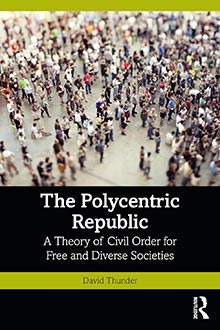
The book was driven by both a positive and negative impulse. It was driven forward by the realisation that our freedom to live flourishing lives depends intimately on a complex social ecology composed of diverse associations that nurture human flourishing in different ways, and that any political system worth its salt must support rather than undermine the ecology of flourishing.
Negatively, the book is motivated by the conviction that the dominant political system of our times – the modern state – has, with a few exceptions, become systematically detrimental to the social ecology of flourishing.
On a more positive note, The Polycentric Republic aims to spell out and support these convictions and explore in some detail their implications for the right and wrong way to structure political authority and political institutions. Above all, it offers a critical re-thinking of the role of the state as the fulcrum of political order.
The Failures of Top-Down Approaches to Social Coordination
The failures of top-down and statist approaches to social coordination and public order are becoming abundantly clear with the implosion of the welfare state, the increasing breakdown of nationalist narratives of identity, the rise of anti-establishment sentiment, and the polarization of national political institutions, which are no longer fit instruments for mediating complex political, cultural, and religious differences.
But if we dig deeper, we can see that the political and constitutional crisis that besets Western democracies today is only the tip of the iceberg. The deeper problem is that increasingly bureaucratised and centralised governments have displaced the role of citizens as co-creators of social order, giving rise to a bewildering and intrusive web of laws and regulations and an onerous taxation system to pay for the state, its army of employees, and its ambitious social projects.
The dominance of state governments, and the organs that depend directly on them, is such that citizens who wish to engage in independent initiatives or create alternative models of community life are often crippled either by expensive red tape or by prohibitively high taxes that siphon off their resources to a central government. The end result, as Alexis de Tocqueville so presciently predicted, is that citizens lose their will to govern their own lives, seeing the state-imposed hurdles to their projects as insurmountable.
The failure of the modern state to deliver welfare and security, and its erosion of civic freedom cannot be properly addressed until we recognize the roots of these failures in the pretension of states to act as the supreme and general source of order for complex and fragmented societies. The attempt to rule complex modern societies from a single centre of power and authority lays the seeds of dysfunctional societies, dominated and contorted by rigid, top-down bureaucracies.
The Centralising Ideology of Order of Modern Democratic States
The advent of democracy, in particular the Glorious Revolution in Britain and the French Revolution in Europe, brought an end to monarchical absolutism and asserted the right of the people to play a pivotal role in the constitution of political power. However, modern democrats continued to attribute supreme and general authority to the state to defend and oversee civil order. The state was supposedly legitimated by “the people”, but it continued to exert a supreme and general form of power over society.
And no amount of representative democracy can remove the fact that the “democratic” state has assumed a form of centralised power over society that far exceeds that of an ancient or early medieval king, who were hemmed in by their technological limitations and by their lack of an integrated form of public administration and finance. By giving a single state monopolistic control over the civil order, modern parliamentarians effectively laid the groundwork for an expansive and overreaching social power, whose fruits included a variety of forms of modern totalitarianism, as well as a dramatic consolidation of the modern bureaucratic-regulatory state over the course of the 20th century.
The paradigm of the sovereign State puts non-state associations, whether schools, universities, churches or municipalities, on an unequal playing field with the state, arming the state with a presumptive claim to exert supreme and general-purpose authority over society at large. This authority comes backed up by military, financial and regulatory monopolies that are difficult for rival actors to resist.
State agencies exert significant pressure over social groups and communities to conform to their regulatory and fiscal demands, even when those demands require them to significantly hollow out or weaken their own internal missions, norms, customs, and ways of life. The case of state regulation of schools and universities, discussed at some length in the book, is especially instructive.
Life Without the Sovereign State Is Not Necessarily A “War of All Against All”
The alternative to the sovereign state is not public disorder or a “war of all against all” but a very different form of social coordination, one that is horizontal and polycentric rather than vertical and monocentric. Whereas statists often expect the worst from horizontal cooperation, or equate it with its worst excesses, polycentrists, including renowned institutional economists such as Elinor and Vincent Ostrom, recognize that, if given a chance, human beings have strong incentives to cooperate constructively with each other, even in the absence of an overarching sovereign power or “Leviathan” to keep them in check.
The particular polycentric arrangement I defend in this book is what I call the “polycentric republic”. The polycentric republic is less a fixed institutional framework than an emergent and evolving horizon of shared interests, values, customs, and rules which citizens and groups develop by cooperating with each other in good faith and negotiating a shared constitution and a mutually acceptable civil order.
This necessary coordination can occur, to a large degree, through multi-lateral and spontaneous exchanges and contracts (what economic theorist Friedrich Hayek called a “spontaneous order”). But it also requires some degree of central management by territorial political authorities. This work develops a set of guiding principles, based on a normative reconstruction of federalism, for constituting and co-ordinating such territorial authorities polycentrically or horizontally, in the absence of any sovereign State.
The Polycentric Republic proposes bottom-up federalism. The principles are consistent with a careful interpretation of the principle of subsidiarity and are intended to provide a basis for a free, vibrant and capacious social order, open to a much larger degree of social and institutional pluralism, and a wider range of pro-flourishing associations and communities, than hierarchical, top-down political orders.
The Polycentric Republic: A Theory of Civil Order for Free and Diverse Societies (Routledge, 2025), was awarded the 2025 Expanded Reason award by the Joseph Ratzinger Vatican Foundation and Francisco de Vitoria University.