

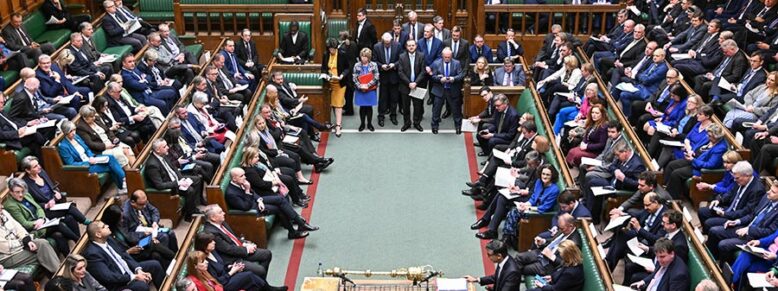

The term filibuster refers to the parliamentary practice of intentionally delaying or blocking a vote by either making unnecessarily long speeches or raising unnecessary procedural points. According to the UK Parliament glossary, filibustering is ‘to deliberately waste time during a debate’ so that a bill is ‘talked out’, stopped from making progress in the time allowed. The demise of the Terminally Ill Bill raises two important questions: first, did the Lords act undemocratically and second, did some of the Lords intentionally make unnecessary interventions, thereby wasting time during the debate?
The serious claim that the Lords acted undemocratically does not hold water. Built into the parliamentary process is what is referred to as the Salisbury convention. Under this convention, legislation that is promised in the governing party’s election manifesto is not voted down in the House of Lords, nor is legislation wrecked by amendments intended to prevent its passage. The Salisbury convention thus preserves the principle that an unelected chamber should not frustrate a proposal endorsed by the electorate. The Terminally Ill Bill was a private member’s bill, and so there was no requirement for the Lords to agree to the legislation. Notably, private members’ bills provide a route for backbenchers to initiate legislation but the success rate is very low. Moreover, as a private member’s bill, it did not go through some of the legislative steps expected for such a significant piece of legislation: there was no consultation process, no green paper was produced, no white paper published and there was no formal international comparison. Furthermore, as Lord Falconer, one of the advocates of assisted suicide pointed out, assisted dying is a matter of conscience. This in itself indicates that the Lords should not have simply allowed or approved of the bill without full and proper scrutiny. Procedure in the House of Lords is different from that in the House of Commons. In the Commons, the Speaker selects amendments from those tabled and can group amendments together. The House of Lords is a self-regulating chamber so that selecting and grouping amendments is informal and not binding. This means that a large number of amendments can be tabled and can be individually considered. Many of the Lords who opposed the bill were concerned that a number of important amendments put down in the Commons were not debated. Indeed, many MPs voted in favour of the bill on the understanding that the bill would be further scrutinised in the House of Lords. Simply rubber stamping what happened in the Commons was not a responsible option.
The second serious charge of filibustering suggests that unnecessary interventions were made precisely with the intention of making the bill run out of time. When legislation comes before either the House of Commons or the House of Lords it is a parliamentary duty to scrutinise that legislation. Significantly, in October 2025, after the Commons vote, and in advance of the debate in the Lords, the Equality and Human Rights Commission provided a House of Lords Select Committee with written advice and oral evidence. The main concern of the Commission was that the equality impact assessment related to the bill focussed principally on access issues and did not deal sufficiently with issues related to safeguarding and coercion which might affect people with protected characteristics. The Commission noted particular areas that required further scrutiny: the potential links between elder abuse and assisted dying services; the impact of the bill on people with different ages; the impact on people who are pregnant or who have recently given birth given the risk of post-natal depression and other mental health issues related to pregnancy and birth; the impact on institutions such as hospices that might object to being involved in assisted dying on the grounds of protected religion or belief; the impact on those with a religious belief or none; the impact on people with different ethnicities, especially given the existing health inequalities and lack of services and social support; the impact on people with disabilities, people with mental health issues, people who have just received a diagnosis of a terminal illness; the link between domestic abuse, women’s caring roles and support available to women; and how the bill might affect people in relation to their sexual orientation or gender reassignment. This advice in itself generates very many questions that in turn warranted serious interventions.
In addition to the questions raised by the Equality and Human Rights Commission, there was scrutiny of a large number of issues, among them the competence and training required for professionals involved in assisted dying decisions; problems associated with assessment, notably assessment in person, and by a multidisciplinary team; the possibility to reflect on decisions; access to palliative services; understanding the effects and possible consequences of ingesting lethal drugs; the problem of being motivated by non-medical factors; the professional distance required between co-ordinating and independent doctors; concerns over people with autism, learning disabilities and those adversely affected by negative attitudes to disability; understanding diagnosis and prognosis of a terminal illness; the problem of coercion or pressure and conversations with families and relevant others; and the issue when there are complications after the ingestion of the lethal drug. These important issues do not seem to be unnecessary points. Is deep scrutiny of a bill that has significant implications not only for those who claim to be strong and autonomous, but also for those who are vulnerable, a waste of time?
In the very polarised debate on assisted suicide, it is rather obvious that some people intended the bill to succeed, other people equally clearly intended the bill to fail. This reflects the fact that some people are convinced that what they term assisted dying should be available as a matter of choice for the terminally ill, and often by extension for all those who are suffering, be it physically, mentally, emotionally or psychologically. It is perhaps no coincidence that media reports of the demise of the Terminally Ill bill have been followed by the desperate case of Wendy Duffy, who was not terminally ill, but who ended her life at a Swiss clinic because she could not cope with her grief at the accidental death of her only son. On the other hand some people believe that assisted suicide undermines human dignity because of the implication that loss of control or being cared for by others equates with loss of dignity and, by extension, that there are some lives that are not worth living, that some people are redundant or no longer have a contribution to make to society, or that they have been so abandoned that no one can help or support them through their very dark times.
Being against assisted suicide is not a matter of wanting to interfere in the liberty of others or of stopping a democratic process. Many of those who are against assisted suicide recognise that simply giving people what they want is not for their good or indeed for the good of those who are vulnerable to thinking that their situation also is hopeless, desperate, or inevitably personally devastating in spite of the help of others.
One suggestion of supporters of the bill is that the Commons could use the Parliament Act to override the Lords, but this would be highly unusual. The Parliament Act would apply to the Terminally Ill Bill because, even though it is a private member’s bill, it is considered to be a Public Bill because its provisions change the general law, and it was first introduced in the Commons. If the procedure under the Parliament Act is followed, the assisted suicide bill would be reintroduced in the Commons in the next Session, perhaps as early as May. The bill has to be identical to the one that fell in the Lords. If the bill passes in the Commons and the Lords again fail to pass it, the government could then invoke the Parliament Act and take it directly for Royal Assent. As another mark of democratic principles, the Lords cannot block the same bill twice. Notably, the Parliament Act has rarely been used in the past and only for government bills. However, the scrutiny given to the bill in the House of Lords has demonstrated that there are serious legal and practical questions that remain unresolved, never mind the very real moral problem of enabling or assisting people to kill themselves.


