
They disagree on how the principles should be applied in particular circumstances. A politician of one party, for example, might think that we should have a smaller and more effective welfare state leaving more resources for local action and taking less from families. A politician of a different party may believe in more decisive action at central government level which would involve taxing people more and spending directly to reduce poverty.
Empirical questions matter too. It might be thought that these are irrelevant to a body of teaching that has moral principles at its heart. However, Pope Benedict (when Cardinal Ratizinger) wrote the following:
A morality that believes itself able to dispense with the technical knowledge of economic laws is not morality but moralism. As such it is the antithesis of morality… Today we need a maximum of specialized economic understanding, but also a maximum of ethos so that specialized economic understanding may enter the service of the right goals.
Again, opinions may differ. People of one political perspective might feel that higher taxation undermines family life, work and enterprise in such a way that it makes the problem a government is trying to solve worse. Somebody might look at the evidence and come to a different conclusion. It is the virtue of prudence which ties the empirical to the moral questions.
Different perspectives were reflected in Render unto Caesar. But two messages did come out quite strongly.
The first was the importance of levying taxes moderately and in proportion to ability to pay. In relation to charity, this principle means that we should ensure two things. Firstly, that people have enough money left over after tax to meet charitable obligations. Secondly, we should assess people’s income for tax after deducting from income the charitable contributions that people make. As it happens, the Gift Aid system does this quite well in our country.
In Render unto Caesar, Andre Alves wrote: “Taxes should be moderate as they reduce the ability of a family to undertake their responsibilities – including obligations in charity.” And, in her contribution, Ruth Kelly (a former Treasury Minister and now on the Vatican Council for the Economy) wrote: “If an individual reduces their disposable income by giving to charity, it is right that they are taxed on that reduced disposable income.”
There are many reasons why the state should ensure that it leaves plenty of room for charitable endeavour. Perhaps Pope Benedict put this best in his encyclical Deus caritas est:
The State which would provide everything, absorbing everything into itself, would ultimately become a mere bureaucracy incapable of guaranteeing the very thing which the suffering person—every person—needs: namely, loving personal concern…In the end, the claim that just social structures would make works of charity superfluous masks a materialist conception of man: the mistaken notion that man can live “by bread alone” (Mt 4:4; cf. Dt 8:3)—a conviction that demeans man and ultimately disregards all that is specifically human.
In the same encyclical, Pope Benedict explained the threefold functions of the Church, one of which is charity. He wrote: “The Church’s deepest nature is expressed in her three-fold responsibility: of proclaiming the word of God, celebrating the sacraments, and exercising the ministry of charity. These duties presuppose each other and are inseparable.”
And this function is not something that can be delegated.
Pope Benedict also wrote about how provision of charity was known and admired and crucial in bringing people to the faith in the early Church. It then radically affected the development of the institutional structures of the Church which were sadly destroyed in the Reformation. Though, today, those charitable structures exist today in other forms, of course.
Pope Benedict finishes this section of Deus caritas est by noting: “For the Church, charity is not a kind of welfare activity which could equally well be left to others, but is a part of her nature, an indispensable expression of her very being.”
In the first reading on Divine Mercy Sunday, we read about how the early Church shared their goods – in a radical way. This was not an activity delegated to the political order (just as well given the political situation of the time). It was an act of love which, rather than being carried out at scale, reached scale by being replicated at a small scale. This distinction is important in organising the charitable work of the Church.
One of the problems, perhaps, of the modern welfare state is that it can lead us to think of charity as a marginal obligation. Indeed, it is a paradox that the welfare state developed to fill in the gaps left by voluntary initiative and mutual welfare societies, and now we think of charity as filling in the gaps.
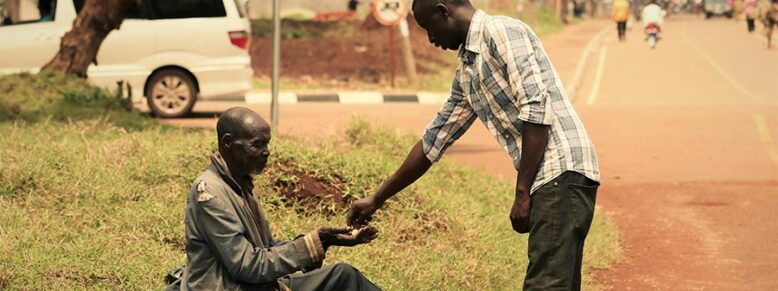
But the call to charity in the Church has always been demanding. Pope Pius XI emphasised, beyond all doubt, the responsibility of the rich to support the less well-off through charity. Firstly, he noted that the obligations of the rich to use their property for the benefit of others went well beyond their obligations in law. Secondly, he stressed that the obligations in this respect were serious, noting: “The Sacred Scriptures and the Fathers of the Church constantly declare in the most explicit language that the rich are bound by a very grave precept to practise almsgiving, beneficence, and munificence”.
The rich, I should say, can fulfil this call in various ways, including through business entrepreneurship – the point is that money should not lie idle and be accumulated for its own sake: it should be put to some good use.
The older encyclicals tended to invoke the language of judgement to a much greater degree than modern encyclicals. This is especially so with regard to the obligations of the rich to the poor. This, for example, is Pope Leo XIII in Rerum Novarum:
Therefore, those whom fortune favors are warned that riches do not bring freedom from sorrow and are of no avail for eternal happiness, but rather are obstacles; that the rich should tremble at the threatenings of Jesus Christ…and that a most strict account must be given to the Supreme Judge for all we possess…
He went on to say that private ownership of goods is the natural right of man. But he then said that, if the question is asked “How must one’s possessions be used?” then the answer is that it is a duty to give to others what we do not need – a duty, not to be required by human law (except in extreme cases), but a duty of Christian charity.
To conclude, the prominence of charity in the readings during Easter; the fact that charity is one of the three pillars of the Church described by Pope Benedict; and the seriousness with which Pope Pius XI and the last Pope Leo took the subject of charity, all point to the profound nature of our obligations to those in need.
We still benefit today from the radical charity of previous generations as we celebrate Mass in the buildings they financed or send our children to be educated in the school buildings.
And, to end on the most positive note imaginable, when we reach the point of judgement, as Pope Leo wrote immediately after his warnings to the rich, God will count a kindness done to the poor as if it has been done to Himself.
—
Image: Ojay Story
—