Business ethics and the common good


Providing Christian commentary on the recent budget is not especially easy. There was a measure to remove the two-child cap on Universal Credit payments that was welcomed by many Christians. But the rest of the budget was really a collection of bits and pieces as well as deferred tax rises on which it is difficult to provide a Christian analysis.
Read more >>
Why should Catholics work to nurture the natural environment? The answer to this It is part of our Christian calling. The teaching of the Church has been clear from the earliest times. In the book of Genesis, it is stated at the end of the creation story “And God saw everything that He had made, and behold, it was very good.” If God proclaims His gift of creation to be good, then we have a responsibility to care for it and use it appropriately.
Read more >>
The topic of fraternity was covered in a post shortly after the death of Pope Francis. It is worth revisiting, especially following Pope Leo’s apostolic exhortation Dilexi te, though this was drafted before that document was issued. The starting point for this post is the question “how might Catholic social teaching affect our everyday lives?”. In particular, I want to consider how it might affect all our everyday lives, not just those involved, for example, in political lobbying.
Read more >>
In this final part of the encyclical, the treatment and protection of the working class is dealt with directly and at length.
Read more >>
We ended Part One of this guide to Rerum novarum with the encyclical’s reminder to the rich that they would have to answer to God if they were not generous with their riches. The focus of that first part was the staunch defence of the right to property. This part will look at the relationship between the state, the family and the Church and the responsibilities we have to the poor.
Read more >>
Pope Francis regularly talked about the conflicts that scar the world. And, of course, Pope Leo has continued to address the tragedy of war in his Angelus addresses and on other occasions. Both popes regularly addressed the environmental crises too – not least, of course, in Pope Francis’s encyclical letter, Laudato si, and in his apostolic exhortation, Laudate deum. It is rare in Catholic social teaching, however, for the two issues to be linked.
Read more >>
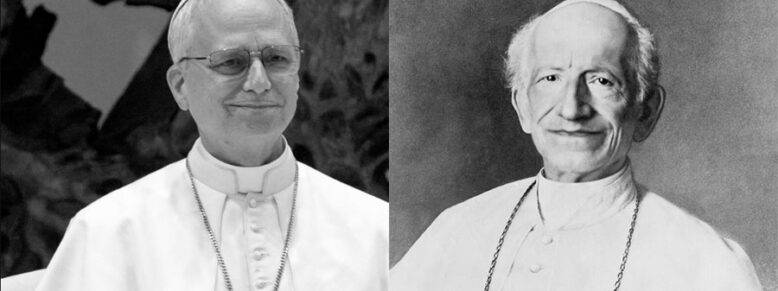
Upon his election, Pope Leo XIV said that he was inspired to take the name “Leo” by Pope Leo XIII’s work on Catholic social teaching. The newly-elected pope especially mentioned Pope Leo XIII’s encyclical, Rerum novarum. Pope Leo XIV related this to the current need to think about things afresh given the development of artificial intelligence (AI). This series of three blogs explores Rerum novarum. It is a radical and holistic call to orientate our whole lives towards God – including in the political, economic and social sectors. To try to distil it for its proposals, as many do, in the political, economic and social domains alone and to take it outside its religious context leaves it stripped of its essence.
Read more >>
In this blog post, first posted on the Centre for Enterprise, Markets and Ethics blog, Neil Jordan discusses the risks of de-humanisation from the use of AI in HR processes
Read more >>
At the beginning of his Pontificate, Pope Leo XIV explained that “in our own day, the Church offers to everyone the treasury of her social teaching in response to another industrial revolution and to developments in the field of artificial intelligence that pose new challenges for the defence of human dignity, justice and labour”.
Read more >>