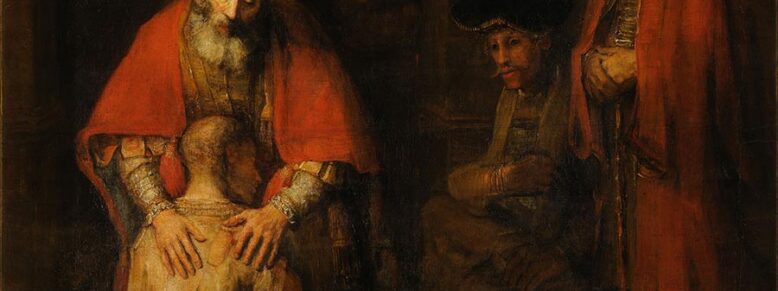
In this blog post, I explain the distinction between social and distributive justice in Catholic social teaching, using the parable of the Prodigal Son.
Read more >>Explaining social justice using the Prodigal Son


In this blog post, I explain the distinction between social and distributive justice in Catholic social teaching, using the parable of the Prodigal Son.
Read more >>
On the website www.catholicsocialthought.org.uk, there is a set of videos that introduce Catholic social thought and teaching. We continue featuring those videos on the blog with the video on Principles of Catholic Social Thought and Teaching which focuses on the four pillars of human dignity, the common good, solidarity and subsidiarity. These are also available in Portuguese .
Read more >>
On the website www.catholicsocialthought.org.uk, there is a set of videos that introduce Catholic social thought and teaching. These will be featured on the blog over the coming weeks. These are also available in Portuguese .
Read more >>
This article does not address the risks or dangers of artificial intelligence – that subject is covered in multiple places. Nor will it go into the questions that fascinate me as a philosopher: the nature of intelligence, consciousness, self‑awareness, etc. Instead, it will address an important practical topic. I will reflect on how AI can serve humanity and the Church.
Read more >>
Why should Catholics work to nurture the natural environment? The answer to this It is part of our Christian calling. The teaching of the Church has been clear from the earliest times. In the book of Genesis, it is stated at the end of the creation story “And God saw everything that He had made, and behold, it was very good.” If God proclaims His gift of creation to be good, then we have a responsibility to care for it and use it appropriately.
Read more >>
In this final part of the encyclical, the treatment and protection of the working class is dealt with directly and at length.
Read more >>
We ended Part One of this guide to Rerum novarum with the encyclical’s reminder to the rich that they would have to answer to God if they were not generous with their riches. The focus of that first part was the staunch defence of the right to property. This part will look at the relationship between the state, the family and the Church and the responsibilities we have to the poor.
Read more >>
Upon his election, Pope Leo XIV said that he was inspired to take the name “Leo” by Pope Leo XIII’s work on Catholic social teaching. The newly-elected pope especially mentioned Pope Leo XIII’s encyclical, Rerum novarum. Pope Leo XIV related this to the current need to think about things afresh given the development of artificial intelligence (AI). This series of three blogs explores Rerum novarum. It is a radical and holistic call to orientate our whole lives towards God – including in the political, economic and social sectors. To try to distil it for its proposals, as many do, in the political, economic and social domains alone and to take it outside its religious context leaves it stripped of its essence.
Read more >>
This document was published by the Dicastery for the Doctrine of the Faith and Dicastery for Culture and Education on 14th January 2025. Below is a summary which follows the headings and structure of the original document.
Read more >>
Professor Carole Murphy, Dr Ashley Beck and Ms Maggie Doherty recently presented at an important international conference exploring how to build resilience in solidarity with partners and colleagues in conflict zones. The conference was led and organised by the University of Notre Dame, alongside a Consortium of ten Catholic Universities. It took place at the Notre Dame Rome campus from 31 July to 2 July.
Read more >>