In this blog post, I explain the distinction between social and distributive justice in Catholic social teaching, using the parable of the Prodigal Son.
Read more >>Explaining social justice using the Prodigal Son
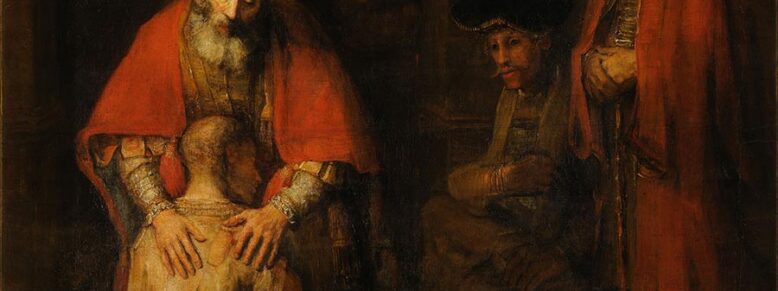


In this blog post, I explain the distinction between social and distributive justice in Catholic social teaching, using the parable of the Prodigal Son.
Read more >>
On the website www.catholicsocialthought.org.uk, there is a set of videos that introduce Catholic social thought and teaching. These will be featured on the blog over the coming weeks. These are also available in Portuguese .
Read more >>
“The Polycentric Republic”, published this year by Routledge, shows how modern ideas of governance neglect the interests and prerogatives of non-State associations and legitimate an imposing sovereign state that jeopardizes the freedom and integrity of communities and associations. In the book, David Thunder invites us to reimagine civil order in a way that is more friendly to the diverse interests and prerogatives of non-state communities and organizations, from churches, schools, and universities to farming co-ops, businesses, villages, and towns.
Read more >>
A recent article reports on work by researchers at Anthropic, the AI lab that developed a ‘reasoning’ AI model, and their ability to look into the digital brains of large language models (LLM). Investigating what happens in a neural network as an AI model ‘thinks’, they uncovered some unexpected complexity that would suggest that, on some level, an LLM might have a grasp of broad concepts and does not simply engage in pattern matching. Conversely, there is evidence to suggest that when a reasoning AI explains how it has reached a conclusion, its account of how it has reasoned does not necessarily match what the ‘digital microscope’ suggests has gone on. Moreover, sometimes, an AI will simply produce random numbers in response to a mathematical problem that it can’t solve and then move on. On occasion, it will respond to a leading question with reasoning that leads to the suggested conclusion, even if that conclusion is false. Thus, it seems, the AI will appear to convince itself (or the human interlocutor) that it has reasoned its way to a conclusion when in fact it has not.
Read more >>
The term “social justice” leads to a lot of sabre rattling in Catholic social teaching circles. Greater attention to its meaning, including to some of the ambiguities about its meaning, might be helpful in promoting more fruitful discussion. Debates are often clouded by bringing F. A. Hayek’s disdain for the whole idea of social justice into the discussion. Supporters of a free economy, in the spirit of Hayek’s work, are therefore pitted against supporters of social justice in Catholic social thought. Constructive dialogue is impeded.
Read more >>
It is sometimes tempting to think of Catholic social teaching as being based in political philosophy, informed, of course, by aspects of theology, whilst forgetting the transcendental aspects of our faith. We cannot, though, divorce any aspect of Christian endeavour from our understanding of God, the Christian mysteries and the incarnation. This includes consideration of the social teaching of the Church. However dark some aspects of the world are today, a light shines in the darkness! In that context, I thought that Fr. William Massie’s sermon at Christmas was an appropriate post on this blog. Fr. William is Catholic Chaplain at the University of Hull.
Read more >>