The promotion of human dignity is a fundamental tenet of Catholic social teaching. In this post examines how vulnerable women coerced by their partners need the protection of the law
Read more >>Does abortion at home fuel domestic abuse?



The promotion of human dignity is a fundamental tenet of Catholic social teaching. In this post examines how vulnerable women coerced by their partners need the protection of the law
Read more >>
The provision of public services by the government has always raised concerns about the respect for individual liberty. And in the case of education, this issue gets even more relevant. For being a vehicle of transmission of knowledge, education contributes not only to tackle ignorance and to increase the level of literacy of the population, but also to create and promote a common set of values and behaviour patterns. In this post we analyse the perspective of Catholic social teaching on the provision of education by the government.
Read more >>
In the late 1970s I lived in rooms in Oriel College, Oxford, a few metres from the infamous statue of Cecil Rhodes in the city’s High Street. I don’t recall the statue, or the smaller ones also on the wall (including Cardinal William Allen) ever being discussed. Rhodes was only at Oriel for one term in 1873, leaving a lot of money to the college and to the university, partly for the scholarships bearing his name. What does Catholic Social Teaching have to say about the statue’s future, and that of similar monuments?
Read more >>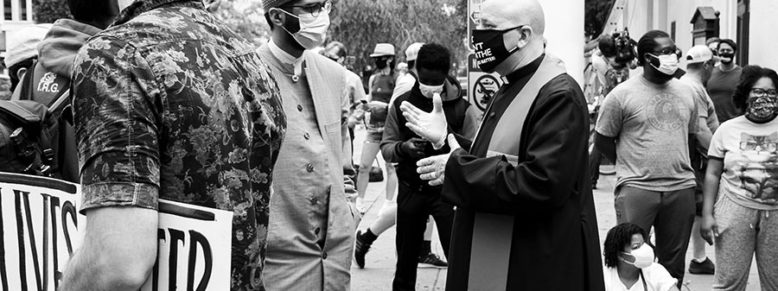
Rapidly developing events and protests springing from the United States to much of the Western world (and elsewhere) have once again brought discussion about individual rights and equality – both in theory and in practice – to the forefront of public debate.
Read more >>
Earlier this year, we commemorated the one hundredth anniversary of the birth of Karol Wojtyla, Pope John Paul II. A multitude of articles, conferences and events has marked the date but perhaps the best way to recall John Paul II is through the authorised biography produced by George Weigel titled “Witness to Hope” and first published in 1999.
Read more >>
This post by Philip Booth considers freedom of speech, conscience and religion in the context of specific laws in the UK which allow a great deal of administrative discretion in restricting those freedoms.
Read more >>
In this post, Philip Booth discusses how the language we use in debates can get in the way of agreement and how Catholics interested in environmental issues should study the work of Elinor Ostrom for inspiration.
In the last blogpost on this site, I wrote about the importance of private property rights for environmental conservation. But there is more to this debate. And sometimes semantics gets in the way of reaching a common understanding on these issues. My garden, for example, is private property and nobody would doubt that. However, a community of monks might care for their (possibly very large) grounds, farm, gardens, bee hives, and so on by holding it in common – though they still hold it privately in common. Indeed, property titles can be quite complex. Under English law, there will sometimes be restrictive covenants, nested leaseholder and freeholder arrangements and property held under trust (including by charities such as the National Trust) and many of these devices will be designed to ensure good outcomes when it comes to sustainability.
Read more >>
In this week’s post, Philip Booth discusses the papal encyclical Laudato Si, responding to Pope Francis’ desire for dialogue on the issues raised.
Bishop Robert Byrne of Hexham and Newcastle described Laudato Si, published five years ago next week, as a “prophetic document that has given a theological and spiritual framework to the environmental crisis facing our world”. An earlier post on this blog developed a similar point.
Read more >>
The world is ageing. By 2050 globally there will be more over 60’s than there under 14’s. With that shift come real changes for the Churches that they are only just beginning to consider. No wonder then a week ago the Christian relief and development agency Tearfund published my major study into the needs of older people in Rwanda. Not surprising then that just after the Dicastery for the Laity, Family and Life in the Vatican staged its first ever Congress on the Pastoral Care of the Elderly to explore what challenges the future might hold.
Read more >>
We are all entitled to empathise with different ways of proclaiming Church teaching, and of course with different pontiffs. John Paul II had and Benedict XVI and Francis have particular charisms which different people find attractive. One of the purposes of the MA in Catholic Social Teaching at St. Mary’s, however, is to emphasise the continuity of Church teaching. When it comes to Catholic teaching on the environment, that continuity has been evident – it did not begin with Laudato Si.
Read more >>